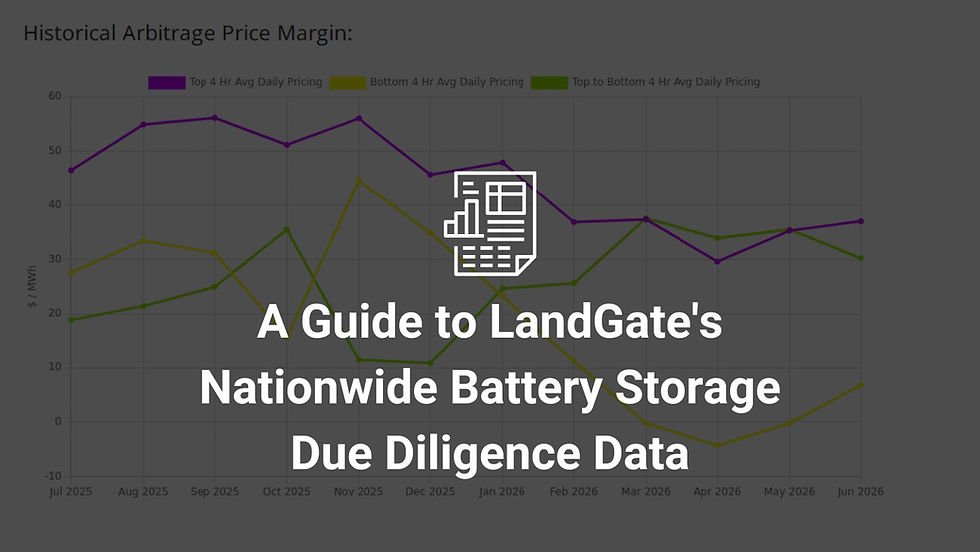
A Developer's Guide to LandGate's Nationwide Solar Due Diligence Report Data


For solar developers, investors, and asset managers, a project lives or dies at the intersection of three questions: can it connect to the grid, what will it earn where it settles, and how do those economics compare to real projects nearby. A strong resource and a clean parcel mean little if the interconnection triggers millions in network upgrades, if the project's pricing node sits well below the trading hub, or if comparable projects are signing offtake at prices this one cannot match. Those questions sit at the heart of LandGate's Solar Due Diligence Report.
This article walks through each section of a Solar Due Diligence Report, explaining what data is provided and why it matters for anyone evaluating whether a solar site is worth pursuing. The figures cited throughout come from the attached sample report, a 69 MWac Solar PV project developed by Aurora Solar in Van Wert County, Ohio, interconnecting at the Maddox substation in PJM and screened against a PJM 2027 summer peak case study. Where an economic report ends in a net asset value and an 8760 report focuses on generation shape, the due diligence report is a screening instrument that combines the physical, the grid, and the market into one view, telling a developer quickly whether a project is a credible one to advance.
Instantly Access Nationwide Solar Data via LLM
LandGate's solar due diligence data is available nationwide and fully optimized for AI. Using our Model Context Protocol (MCP) Server, you can pipe this granular interconnection, pricing, and PPA data directly into your LLMs (like ChatGPT, Claude, or internal tools) to automatically screen candidate projects, programmatically rank sites by network-upgrade cost or price basis, and stress test locational revenue across thousands of parcels in seconds.
Starting Point: The Score Card
The report opens with a score card that orients the reader to the project. It lists the core identifying attributes (operator and developer, development status, AC capacity, lease and scheduled operating dates, the interconnecting substation, whether energy storage is included, and location), along with a project contact. In the sample, the project is a 69 MWac asset operated by Aurora Solar, currently at Site Control status, with a scheduled operating date of January 9, 2026, interconnecting at the Maddox substation in Van Wert County, Ohio, and no paired energy storage.

This score card matters because it fixes the stage and context that condition everything downstream. A Site Control project carries different risk and timing than one under construction, the interconnecting substation anchors the entire grid analysis that follows, and the AC capacity scales every generation and revenue figure. Surfacing the operator, status, and interconnection point up front lets a reader immediately gauge how far along the project is and where its grid story will play out.
Lifetime Generation Summary and Generation by Year
Before the grid and market analysis, the report establishes how much the project will physically produce. It presents the headline output at three points in time and then unfolds it across the full operating life. For the sample, Year 1 generation is 162,915 MWh at a 27 percent capacity factor, the final year falls to 131,147 MWh at 21.7 percent, and lifetime generation totals 5,881,246 MWh at a 24.3 percent lifetime capacity factor. A companion table lays out all 40 operating years, stepping down by a steady 0.5 percent of the original each year to 80.5 percent of the starting output by Year 40.

The capacity factor is the key efficiency metric, translating installed capacity into delivered energy, and the year-by-year degradation schedule is the assumption every revenue projection rests on. A monthly generation chart accompanies the summary, showing the seasonal curve that peaks in summer and the steady compression of output across the snapshot years. This is the physical foundation the rest of the report builds on: the grid analysis determines whether that generation can flow, and the pricing analysis determines what it will earn.
System and Study Details
Because the interconnection analysis is only as credible as the model behind it, the report is transparent about that model. It documents the ISO or RTO, the specific case study modeled, the grid model and sensitivity used, the date the study was run, and the scale of the network analyzed. For the sample, the analysis runs on PJM using the PJM 2027 Summer Peak (Series 2025) case, an 8-bus reduced grid model with a Base Case plus contingencies sensitivity, run on June 18, 2026, across a network of 507 substations, 1,359 buses, and 1,182 lines carrying 15,477 MW of generation against 7,837 MW of load.

These details matter because they let a reader judge the basis of the interconnection results rather than taking them on faith. Knowing the case study, the reduced-model resolution, and the generation-to-load balance in the studied network tells a developer how conservative or optimistic the conditions are, and a system map color-coded by transmission voltage grounds the analysis in the real grid around the project. This section is what separates a defensible interconnection screen from an unexplained number.
ATC Results
This is the core interconnection screen. It reports the project's available transfer capability at its point of interconnection, identifies the specific limiting elements that constrain injection, and estimates the network upgrade cost required to interconnect. For the sample, the 69 MWac project interconnecting at Maddox (05MADDOX) under Network Resource service shows three limiting elements, all 345 kV lines in the surrounding network, and, critically, a total network upgrade cost estimate of $0.

That zero-dollar upgrade estimate is the headline result, and it is exactly the kind of finding that can make or break a project. Interconnection cost is one of the largest and least predictable line items in solar development, and a clean interconnection with no required network upgrades at the project's size is a strong positive signal. By naming the limiting elements and their transfer limits alongside the upgrade cost, the report shows not just the bottom-line number but what drives it, letting a developer understand how much headroom exists before additional capacity would trigger expensive upgrades.
ATC vs Ranked Generation Capacity
Where the ATC results address whether the project can connect, this section addresses whether the grid can actually absorb its output across every hour of the year. It plots the project's generation against ranked hours alongside the available transfer capability and the queue of other projects, and it reports the resulting curtailment. For the sample, the analysis shows a production start of January 9, 2026, with zero curtailed hours and zero curtailed MWh.

Zero curtailment is a meaningful result, because a project that must spill energy during high-output hours earns less than its nameplate would suggest. The section also lists the surrounding generators by bus, capacity, and participation factor, which reveals the local generation stack the project competes with for grid capacity. Together, the curtailment finding and the local generation context tell a developer how much of the modeled generation will actually reach the market and how crowded the local grid already is, both of which feed directly into a realistic revenue expectation.
Pricing: Node vs Hub Basis
For a solar project, revenue depends not just on how much it generates but on the price where it settles, so the report dedicates a section to the market signal at the project's specific pricing node. It compares prices at the PJM trading hub against prices at the project's node, expressing the difference as a basis and ranking the location against ISO and state percentiles across trailing and forward periods. In the sample, the node is BLUECREE at the Maddox substation.

The basis here tells an important and cautionary story. In the sample, the node consistently prices below the hub, with a negative delta that widens from roughly $12/MWh over the trailing 60 months to an estimated $24/MWh over the next 60 months, while the location ranks in the low percentiles within both PJM and the state. A negative and widening basis, combined with low percentile rankings, signals a weaker-priced location where the project captures less value than the headline hub price implies. This is precisely the kind of locational revenue risk that is invisible without node-level pricing, and surfacing it early lets a developer weight it against the project's clean interconnection and solid generation.
Historical and Forecasted Price Behavior
To put the levelized pricing in context, the report charts both how prices have actually behaved and how they are forecast to move. The historical charts compare the node against the hub day by day over the trailing year, plot the delta over time, and show the percentage price differential, capturing both the typical basis and its tail events, including a sharp winter price spike in the sample. The forecast charts then extend the node and hub comparison forward, with the projected delta by month.

These time-series views matter because a single levelized number hides the volatility and seasonality that shape real revenue. The historical charts reveal how often and how severely the node diverges from the hub, and the percentage differential shows how consistently the node underperforms. The forecast charts give a forward basis a developer can build into a revenue model, showing the delta holding in the range of roughly $18 to $25/MWh below the hub across the projection. Seeing both the realized and forward behavior lets a developer model node revenue with a realistic sense of its variability rather than a single point estimate.

PPA Comparables
The report closes by benchmarking the project against real offtake in the same region. It lists nearby solar projects with their operators, distances, contracted PPA prices, development status, and capacities, and charts the project's implied pricing against those comparables and the regional average. For the sample in PJM, the comparables include Bellflower Solar 1 (91 miles, $31/MWh, 152.5 MWac), Big Plain Solar (98.6 miles, $30/MWh, 196 MWac), and Wyandot Solar Farm (65.1 miles, $253/MWh, 10 MWac).

These comparables matter because they translate abstract market pricing into the actual terms nearby projects have signed. The tight cluster of larger projects contracting around $30/MWh, alongside a small outlier project at a much higher price, gives a developer a grounded sense of what offtake this project might realistically command and where it sits relative to the market. Pairing real PPA benchmarks with the node-level pricing analysis lets an investor judge not just what the project could earn on the merchant market, but what a contracted revenue path might look like.
What This Solar Due Diligence Report Tells You and What It Doesn't
A LandGate Solar Due Diligence Report is a screening tool. It combines generation, interconnection, pricing, and PPA benchmark data into a single picture that is directionally accurate and immediately useful for deciding whether a project deserves deeper investment. It is not a substitute for the formal interconnection cluster study, independent engineering report, detailed financial model, and confirmed offtake terms that a project requires to reach financial close. The interconnection results in particular rest on a reduced 8-bus model and a specific case study, which makes them indicative rather than final.
Report Section | Decision It Supports |
Score Card | Orienting to project identity, status, and interconnection point |
Lifetime Generation Summary | Establishing headline output and capacity factor |
Generation by Year | Modeling degradation across the operating life |
System and Study Details | Understanding the power-flow basis of the interconnection analysis |
ATC Results | Estimating interconnection feasibility and network-upgrade cost |
ATC vs Ranked Generation Capacity | Assessing curtailment risk and local generation competition |
Pricing (Node vs Hub) | Weighing locational basis and revenue risk |
Historical and Forecasted Pricing | Modeling realized and forward price behavior |
PPA Comparables | Benchmarking against real nearby offtake prices |
What comes after a strong screening is detailed interconnection study, independent engineering, and negotiated offtake. The report's value is in giving developers and investors enough information to decide quickly whether a project's grid access, pricing, and market position justify that deeper commitment of time and capital, and to enter those later stages with a clear-eyed view of where the risks lie.
Accessing Solar Due Diligence Data
The gap between a project that looks buildable and one that actually pencils is almost always a matter of grid access and locational pricing, factors that interact in ways that are difficult to judge by intuition. LandGate's Solar Due Diligence Report brings that full picture forward to the screening stage, giving developers and investors a data-driven read on interconnection cost, curtailment, node pricing, and PPA benchmarks before significant capital is committed. For anyone evaluating multiple candidate projects, it turns grid and market viability into a screening criterion rather than a late-stage discovery.
Integrate with your enterprise LLM of choice: Unleash infinite possibilities by pulling our nationwide property and generation data straight into your LLMs via the LandGate MCP Server. Programmatically generate custom generation profiles, automate portfolio-wide production screening, and build tailored internal dashboards instantly.
See it in action first: Want to view a complete, ready-to-use breakdown before connecting your systems?
Talk to our team: Ready to scale your solar screening operations nationwide? Schedule a personalized walkthrough with our dedicated energy and infrastructure experts.
LandGate Solar Due Diligence Reports are based on project parameters, grid and market data, modeled interconnection results, and market pricing forecasts. Results are directional estimates intended for screening purposes and should not be used as a substitute for a project's formal interconnection cluster study, independent engineering review, detailed financial model, or confirmed offtake and financing terms. Actual grid access, interconnection cost, curtailment, market pricing, and project value may differ from report findings.