
What the Google-Anthropic Data Center Deal Means for Developers


The recent Financial Times report regarding Google’s plan to finance a multibillion-dollar Texas data center for Anthropic marks a pivotal shift in the "AI arms race." While the headline focuses on the partnership, the real story for developers is the engineering workaround: the facility is designed to run almost entirely on direct natural gas supplies, effectively bypassing the electrical grid.
This isn't just an outlier; it is a blueprint for the "AI Superfactory" era. As power demand scales at a rate that traditional utilities simply cannot match, the definition of a "prime site" is being rewritten.
The Interconnection Breaking Point
For years, the industry has operated under the assumption that the grid would eventually catch up. However, the FT report underscores a harsh reality: wait times for massive interconnection requests in markets like ERCOT and PJM have shifted from "inconvenient" to "project-killing."
When a facility requires upwards of 1GW (roughly the output of a nuclear reactor), waiting 5 to 7 years for a substation upgrade is no longer a viable business model. We are seeing a massive flight to "energy-proximate" land. In our internal mapping of the Texas landscape, the most valuable parcels are no longer those closest to transmission lines, but those sitting at the intersection of high-capacity natural gas pipelines and fiber backbones.
Shifting Data Centers From "Consumer" to "Generator"
The Google-Anthropic strategy for the site in Hubbard, Texas highlights a transition from data centers acting as passive utility customers to becoming independent power islands. By utilizing on-site natural gas generation, developers gain two critical advantages:
Speed to Market: You can build a gas-fired plant faster than a utility can upgrade a congested 345kV line.
Cost Certainty: By sourcing gas directly, hyperscalers hedge against the volatility of Locational Marginal Prices (LMPs) in congested nodes.
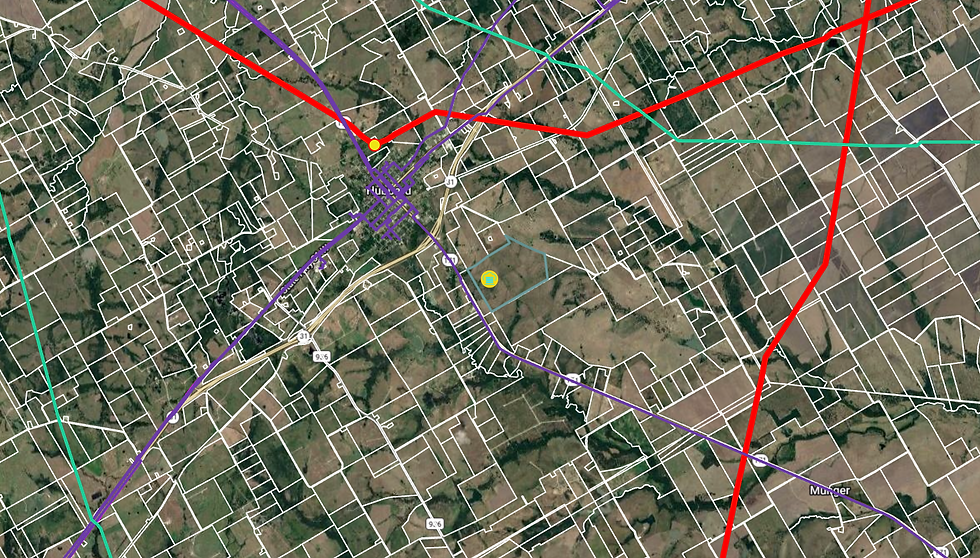
Success in this "off-grid" model requires a level of due diligence that goes beyond surface-level site assessments. To make these deals work, developers must analyze the diameter and pressure of nearby gas pipelines alongside traditional metrics. Our data indicates that while many sites appear "industrial," only a small fraction possess the specific "Infrastructure Stack", or the confluence of gas volume, water for cooling, and fiber latency needed to support a site of this magnitude.
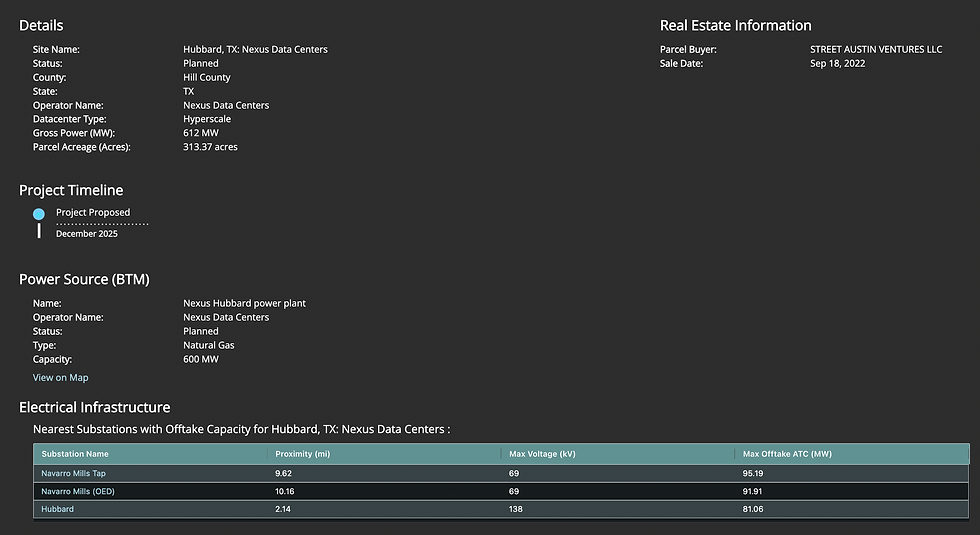
The New Texas Blueprint Modeled by Google & Anthropic
Texas is the logical staging ground for this experiment due to its deregulated market and massive gas reserves, but the scarcity of "ready-to-go" sites is intensifying. As developers look to replicate this "behind-the-meter" model in other basins such as the Appalachian or the Haynesville, the margin for error is shrinking.
The bottleneck for AI is no longer the availability of chips; it is the availability of power-ready land. The Google-Anthropic deal proves that the winners in this space won't be the ones who wait for the grid—they will be the ones who use granular infrastructure data to find the "hidden" capacity that the rest of the market is missing.
To see how LandGate’s proprietary mapping of pipelines, substations, and fiber can accelerate your data center site selection, connect with our dedicated energy infrastructure team.


