
EPRI Launches New Data Center Flexibility Framework
- Yoann Hispa

- May 20
- 4 min read
How EPRI's Flex MOSAIC Framework Is Rewriting the Rules of Data Center Interconnection
The race to power AI isn't just about gigawatts. It's about time. And right now, time is the one resource the data center industry can't afford to waste.
As artificial intelligence and advanced manufacturing push electricity demand to levels the grid was never designed to handle, a single bottleneck has emerged at the center of nearly every major project: Time-to-Power. Interconnection queues stretch for years. Utilities model every new data center as a worst-case "black box." Developers face custom studies, mounting costs, and stalled timelines before a single server ever goes online.
A new industry framework just changed that equation.
EPRI Launches Flex MOSAIC: A Shared Language for Grid Flexibility
On March 23, 2026, at CERAWeek in Houston, the Electric Power Research Institute (EPRI) announced Flex MOSAIC, a uniform flexibility classification framework for large electric loads, built through its DCFlex initiative in collaboration with more than 65 utilities, system operators, regulators, hyperscalers, and technology providers.
The core idea is straightforward but transformative: rather than treating every data center as an unpredictable draw on the grid, Flex MOSAIC gives operators, utilities, and developers a common vocabulary to define and communicate exactly how flexible a load can be, based on the magnitude, timing, duration, and frequency of its response.
As EPRI President and CEO Arshad Mansoor put it, "flexibility is becoming the third leg of the speed-to-power stool, alongside generation and transmission."
Why the "Black Box" Problem Has to End
Traditionally, utilities have had no reliable way to assess what a new data center would actually demand of the grid. Every project required custom modeling. Every interconnection study started from scratch. The result? Interconnection timelines measured in years, not months — and a growing gap between the speed of AI deployment and the pace of grid infrastructure.
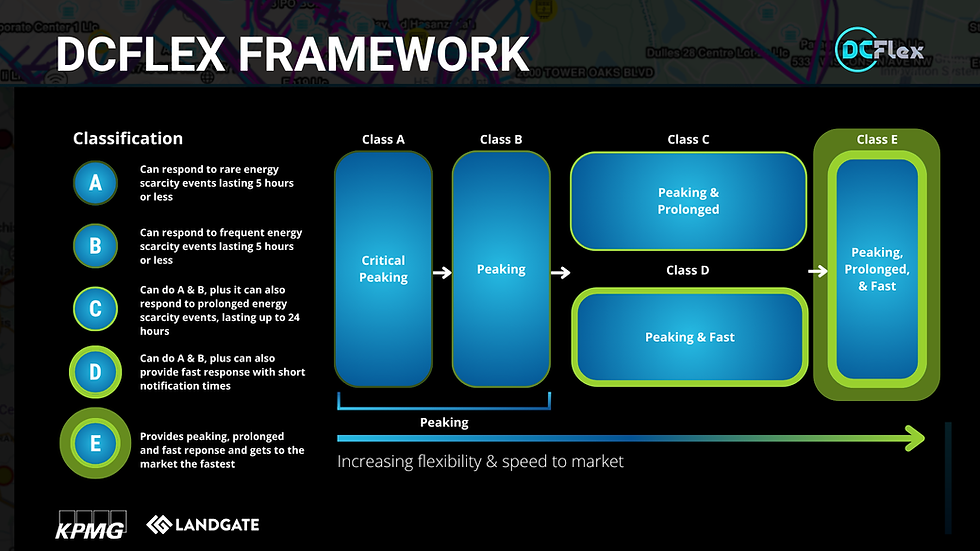
Flex MOSAIC solves this by introducing five performance-based DCFlex Flexibility Classes that describe exactly what kind of grid support a facility can provide:
Class | Capability |
Class A: Critical Peaking | Response to rare scarcity events (5 hours or less) |
Class B: + Peak | Response to frequent scarcity events (5 hours or less) |
Class C: + Prolonged | Adds response to prolonged events up to 24 hours |
Class D: /+ Fast | Adds fast response with short notification times |
Class E: Fully Dispatchable | Full combination of peaking, prolonged, and fast response |
By classifying large loads based on performance rather than just technology, the framework enables utilities and developers to plan together with confidence, reducing the need for bespoke modeling, speeding interconnection, and preserving grid reliability as massive new loads come online.
LandGate and KPMG: Committed to the Framework from Day One
At LandGate, in partnership with KPMG, we are proud to be early supporters of the EPRI DCFlex framework and we're already putting it to work for our clients.

LandGate and KPMG have an established partnership focused on bridging the world of digital infrastructure and energy systems. KPMG's National Renewable Energy Group brings deep expertise in tax, valuation, and advisory services for large-scale energy and infrastructure projects. LandGate brings the most comprehensive land, grid, and infrastructure data platform in the U.S. including precise transmission and substation mapping, interconnection queue visibility down to the node level, and siting analytics that surface grid headroom before a single dollar is committed.
Together, we are applying the DCFlex framework to help clients:
Design for flexibility from the start — not as an afterthought, but as a core siting and development criterion
Streamline interconnection by matching project capabilities to grid needs in the language utilities now recognize
Optimize site selection by identifying locations where a project's specific flexibility class unlocks existing capacity
Reduce deployment risk and increase ROI by getting to power faster
What This Means for the Industry
The participants in Flex MOSAIC's initial launch include Google, Meta, NVIDIA, Siemens, Constellation Energy, Southern Company, Exelon, MISO, CAISO, and Arizona Public Service, among others. The framework is voluntary but the momentum behind it signals that standardization is no longer optional for serious players in the space.
NERC President Jim Robb called a common framework like this "essential for maintaining a reliable grid." NARUC President Ann Rendahl noted that state regulators are watching closely, focused on ensuring that the costs of serving massive new loads don't fall on existing ratepayers and that frameworks like Flex MOSAIC offer a path forward that benefits all stakeholders.
For data center developers and investors, the message is clear: Projects that can credibly demonstrate their flexibility class will move faster, face fewer regulatory hurdles, and access capital on better terms.
LandGate and KPMG are committed to helping clients navigate this transition with clarity and confidence. In the coming months, look for new datasets, reports, white papers, and joint webinars designed to put the Flex MOSAIC framework into practice — helping you design flexible facilities, identify the right sites, and get to power faster.
The grid now has a shared language. LandGate and KPMG are here to help you speak it fluently.
Interested in how the DCFlex framework can accelerate your next project? Connect with LandGate and KPMG to learn more.


