
Siting Data Centers on the Subtransmission Grid


When a data center site selection team starts evaluating a new market, most of the conversation centers on the same things: proximity to bulk transmission, substation capacity, utility relationships, and interconnection queue position. Those are the right questions. But there is a layer of the grid sitting between bulk transmission and the local distribution system that rarely gets mapped, modeled, or even discussed until a project is already deep into feasibility. That layer is subtransmission, and for hyperscale campuses, colocation facilities, and edge deployments alike, it is increasingly the variable that determines whether a site can actually be powered.
LandGate has mapped nearly 430,000 subtransmission lines across the United States, combining voltage, length, hosting capacity, available transfer capacity, line tap data, and historical generation by fuel type into a single queryable layer. This post explains what subtransmission is, where it fits in the grid hierarchy, and why having this data at your fingertips before you sign an LOI can meaningfully change development outcomes.
What Subtransmission Is and Why It Matters for Data Center Siting
The U.S. grid moves electricity through three broad tiers before it reaches a facility's meter; bulk transmission, distribution, and subtransmission.
Infrastructure | Typical Use for Data Centers |
Distribution lines | Small facilities only |
Subtransmission lines | Often suitable for small to medium campuses depending on available capacity |
High-voltage transmission lines | Preferred for hyperscale campuses with very large power demands |
Subtransmission sits between bulk transmission and local distribution. In LandGate's dataset, that means the 39.5 kV to 138 kV range, the segment of the grid that carries power from major substations out to distribution points and, in many cases, directly to large industrial and commercial customers. Voltages of 69 kV, 115 kV, and 138 kV are commonly used for subtransmission in North America.
Data centers of all types connect at this level. Colocation facilities in the 5 to 50 MW range typically interconnect at 69 kV or 115 kV. Hyperscale campuses push into 115 kV to 138 kV territory depending on utility standards and load requirements. Edge deployments at the 1 to 10 MW range receive power through distribution substations that are themselves fed directly from subtransmission lines, making the health of those lines a direct input to site reliability.
The critical difference from bulk transmission is structural. Subtransmission networks are distributed across a much broader geographic footprint, they are managed at the utility level rather than the ISO level, and they are not subject to the same interconnection study processes that make bulk transmission queue timelines so punishing. The full large load interconnection process can take anywhere from several months to several years from initial request to full energization, making it one of the most significant schedule and cost determinants in large load project development. Sites that connect at subtransmission voltages to lines with existing hosting capacity can land toward the faster end of that range. Sites that trigger bulk transmission upgrades sit at the other end.
Why Subtransmission is the New Frontier for Data Center Speed-to-Market
While the data center industry has been hyper-focused on major bulk transmission corridors, the subtransmission grid - typically operating between 34.5kV and 138kV - has quietly remained the most agile alternative for mid-sized and modular data center deployments.
Consider ERCOT as a prime example. In Texas, the queue to connect massive loads to the primary bulk system can involve exhausting regulatory hurdles and extensive system stability studies. However, stepping down to the 34.5kV-69kV asset class opens up localized utility pathways.
Siting on subtransmission lines offers three distinct advantages:
Drastically Shorter Timelines: Because subtransmission lines handle localized distribution and regional utility routing, connecting to them often bypasses the bloated, multi-year regional RTO/ISO transmission queues, routing you through more nimble localized utility processes instead.
Lower Infrastructure Costs: Tapping directly into a subtransmission line via a localized line tap or existing substation requires far less capital-intensive substation equipment than dropping a new substation off a massive 500kV bulk line.
Untapped, Distributed Pockets of Capacity: Because industrial load has historically clustered around major transport hubs, massive swathes of suburban and rural subtransmission lines sit significantly underutilized.
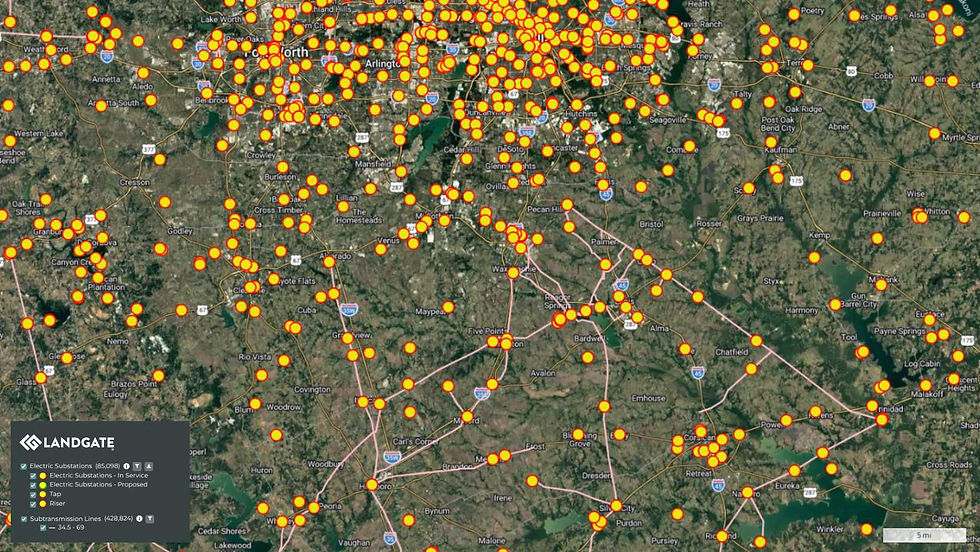
However, hunting for capacity on the subtransmission grid historically felt like flying blind. Utilities rarely publish granular data on lower-voltage lines, leaving data center developers to gamble hundreds of thousands of dollars on speculative interconnection applications just to see if a line has headroom. LandGate’s vertical intelligence platform changes that.
Hosting Capacity and ATC: Two Important Metrics
Not every subtransmission line is a development opportunity. The variables that separate a fast-track site from a multi-year upgrade obligation are hosting capacity and available transfer capacity, and both are now surfaced in LandGate's Electrical Infrastructure data layer at the line level.
Hosting capacity is the amount of additional load a given line can absorb without requiring infrastructure upgrades. A line with meaningful hosting capacity can accept a new connection and begin delivering power on a timeline that compresses with the utility's study process, not an upgrade construction schedule. A line with exhausted hosting capacity triggers the same upgrade obligation cascade that makes bulk transmission queues so expensive, regardless of voltage class.
Available transfer capacity (ATC) tells you whether power can actually flow to your point of interconnection under current grid conditions. High ATC means the network upstream of your site has room to move power without hitting congestion limits. Low ATC, even on a line with nominal hosting capacity, introduces curtailment risk and can complicate interconnection study outcomes.
Together, these metrics define what developers should think of as the sweet spot: a subtransmission line in the 69 kV to 138 kV range where hosting capacity is high enough to serve an initial load phase without triggering network upgrades, and ATC confirms that the broader segment can deliver. That combination is rare enough in saturated markets like Northern Virginia and Phoenix that it represents a genuine competitive signal when found, and common enough across secondary geographies that systematic screening with LandGate's layer surfaces actionable candidates.
The practical application differs by data center type. For a hyperscale developer, the screen might prioritize 115 kV to 138 kV lines with hosting capacity above 100 MW, filtered by ATC and proximity to land that clears zoning and acreage requirements. For a colocation operator, 69 kV to 115 kV lines with 10 to 50 MW of headroom may be sufficient. For edge deployments, the relevant filter is the subtransmission line feeding the distribution substation closest to the target location, assessed for whether it can support the distribution substation's expansion without a supply-side constraint.
Line Tap Data: Narrowing the Field Further
Within the set of lines that clear the hosting capacity and ATC filters, line tap data adds another layer of signal. A line tap is a connection point on an existing subtransmission or transmission line where power can be accessed without a new full substation on the tapped line. Tap locations are significant for siting because a site adjacent to an existing tap on a high-capacity line may be able to interconnect with substantially less civil and electrical infrastructure than one that requires a new connection engineered from scratch.
LandGate's subtransmission layer includes detailed tap data for each mapped line. In a practical screening workflow, this means a developer can identify not just which lines have capacity, but which lines have existing connection infrastructure in proximity to candidate parcels. For hyperscale sites where interconnection infrastructure costs can run into tens of millions, the difference between tapping an existing point and building a new service entry is a meaningful input to the development budget long before a site visit happens.

For edge deployments in particular, where project economics are tighter and the cost of a new service connection can disproportionately affect returns, tap proximity is often the variable that determines whether a specific parcel pencils out.
How LandGate's Subtransmission Layer Fits Into the Data Center Siting Workflow
LandGate built the subtransmission layer specifically to surface this kind of pre-screening intelligence at scale. The 430,000-line dataset spans the full U.S. subtransmission network and integrates hosting capacity, ATC, voltage, line length, tap data, and historical generation by fuel type into a single queryable map layer.
The workflow integration is straightforward: before submitting a utility pre-application or commissioning a feasibility study, a developer runs their target geography through the subtransmission layer. Lines that clear the hosting capacity and ATC threshold surface as priority corridors. Land parcels within a reasonable distance of high-capacity tap points within those corridors move to the top of the candidate list. The result is a screened set of sites that enters feasibility work with a materially higher probability of clearing the grid viability gate.
That layer sits alongside LandGate's broader infrastructure data, including high-voltage transmission, utility substations, fiber and connectivity infrastructure, zoning and land use, and EPA air quality designations. The multi-layer view matters because grid viability is necessary but not sufficient. A site that clears subtransmission screening still needs to pass zoning, fiber access, permitting, and environmental reviews. Running all of those in parallel from the start, rather than sequentially after a grid check, is how developers compress total feasibility timelines.


