
The New Prize in the Data Center Race Isn't Land. It's Land Next to Power

Updated: 4 days ago

For most of the last decade, the data center conversation was about real estate. Find a big, flat, affordable parcel near fiber, lock it up, and build. That era is over. The binding constraint has moved twice in just a few years: first from land to grid access, and now to a far more specific question. Can this particular parcel get energized, and how soon?
That shift is rewriting how the most sophisticated developers and investors value land. The parcels commanding premium attention today are not simply large or cheap. They are the ones sitting close to existing substation capacity and headroom on the grid. Understanding why requires looking at where the delays now actually live.
The bottleneck moved downstream
Demand is not the problem. U.S. data center electricity draw climbed from roughly 23 GW in 2023 to about 42 GW in 2026, and AI workloads alone could push national demand past 130 GW by the end of the decade. The appetite is enormous and growing. The problem is delivery.

A data center campus can be built in under three years. The power infrastructure to feed it routinely takes far longer. Recent industry data shows that AI infrastructure projects reaching operational status in 2025 took an average of more than seven years from start to finish: roughly three years to secure an interconnection agreement, then another four years waiting to actually come online after approval. The wait is no longer concentrated inside the interconnection queue. It has shifted downstream, into transmission buildouts and substation capacity.

The hardware tells the same story. Substation transformer lead times averaged around 140 weeks in 2023, climbed to roughly 150 weeks in 2025, and now exceed 160 weeks in 2026. That is more than three years just for a transformer, before a single rack is energized. As of early 2026, grid operator PJM reported more than 21 GW of projects sitting in engineering and procurement status, with another 8.2 GW under construction but not yet live.
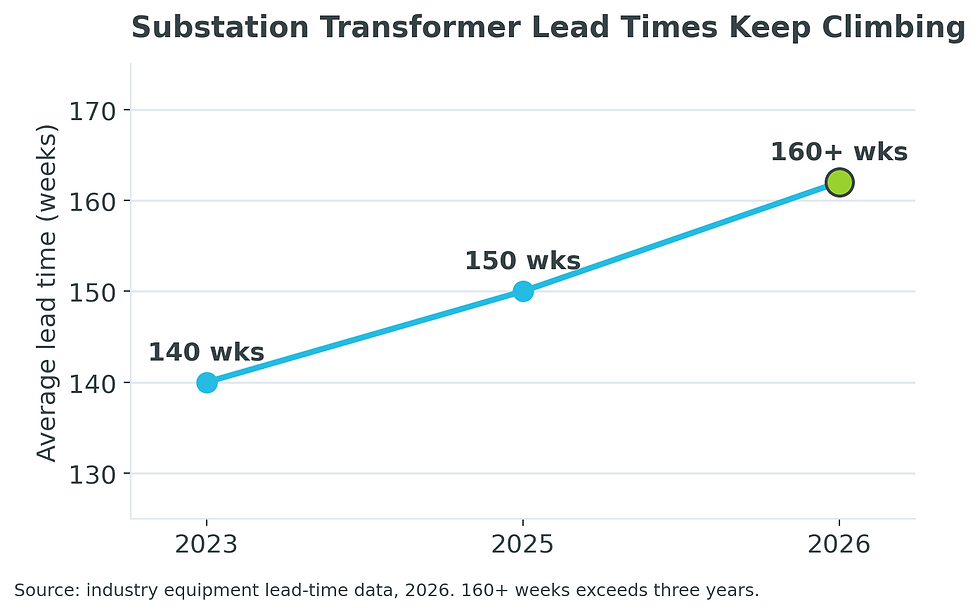
For a developer, every one of those years is carrying cost, risk, and opportunity loss. Time to market has become the single most important variable, and power, not dirt, is what governs it.
Why grid proximity is now the differentiator for data centers
When the scarce resource is energized capacity rather than acreage, the value of a parcel becomes a function of its relationship to the grid. Two adjacent sites with identical price, size, and zoning can be worth wildly different amounts if one sits beside a substation with available injection and offtake headroom and the other faces a seven-year transmission upgrade.
This is the insight reshaping site selection. A parcel's distance to the nearest substation, the voltage and capacity of nearby lines, and whether that point on the grid can actually accept new load are no longer secondary diligence items. They are the first questions a serious buyer asks, because they determine whether a project is viable at all.
The trouble is that this information has traditionally been fragmented, slow to assemble, and hard to compare across markets. Pulling utility filings, queue positions, and substation capacity together for even a handful of candidate sites can take weeks of specialized work. By the time the analysis is done, the best parcels are often gone.
Turning grid data into a siting advantage
This is precisely where LandGate's data changes the calculus. Instead of treating grid access as a black box discovered late in diligence, developers can screen for it up front.
LandGate's substation injection and offtake data lets a buyer see, before making an offer, whether the grid near a parcel can actually accommodate new generation or new load. That single layer of information separates parcels that can be energized in a reasonable window from those that cannot, which is now the difference between a buildable site and a stranded one.

Layered on top of parcel search, this turns site selection into a targeted hunt rather than a guessing game. A developer can filter for parcels of the right size and zoning that also sit within reach of substation capacity, surfacing the rare combination that actually pencils out. Environmental and parcel detail reports then let the team pressure test those finalists for the other constraints, water, land use, ownership, and site conditions, that can sink a project just as quickly as a missing interconnection.
Finding powered land is only part of the equation. Developers also need access to properties that aren’t publicly listed. LandGate is the only platform offering exclusive off-market listings directly from landowners, giving data center developers a competitive edge in securing high-potential sites before they hit the broader market.
For investors and landowners, the same data works in reverse. A parcel you already own may be far more valuable than its acreage suggests if it happens to sit on grid infrastructure that data center developers are now desperate to find. Knowing that before you list, or before you field an inbound offer, is the difference between capturing that premium and giving it away.
The data center boom has not slowed. What has changed is the chokepoint. With transformer lead times stretching past three years and energization timelines running well beyond seven, the winners will be the developers and landowners who can identify grid-proximate, energizable land faster than everyone else.
Land is still necessary. It is just no longer sufficient. The prize now is the parcel that comes with a credible path to power, and the players who can see that path first will define the next phase of the build out.
___________________
To learn more about LandGate’s data and tools for data center developers, book a demo with our dedicated energy & infrastructure team.


