
DOE's $100 Billion Paducah Bet


Inside the site behind Kentucky's new AI and power campus, and what the underlying data shows
The U.S. Department of Energy (DOE) has picked its Paducah Site, a nearly 3,400-acre former uranium enrichment complex in McCracken County, Kentucky, as the anchor for what officials are calling a more than $100 billion private investment in artificial intelligence and high-performance computing. The announcement, made in late July 2026, pairs a data center campus with dedicated power generation built specifically to serve it, a structure the administration is framing as proof that new AI infrastructure does not have to raise electricity bills for everyone else on the grid.
Under the plan, Brookfield will develop and operate a 1.8-gigawatt AI and high-performance-computing campus on the site. NextEra Energy will build and own roughly 2 gigawatts of new natural gas-fired generation alongside up to 2.6 gigawatts of battery storage, dedicated to the campus and, DOE says, capable of feeding surplus power back into the regional grid. Big Rivers Electric Power Corporation will provide wholesale electric service, Jackson Purchase Energy Cooperative will handle retail service, and Paducah Power System is named as a community partner. The Kentucky Public Service Commission still has to approve the underlying power service agreement.
DOE projects roughly 8,000 construction jobs during buildout and about 600 permanent positions once the campus is running, with completion targeted for 2031. Energy Secretary Chris Wright tied the deal to the administration's “Ratepayer Protection Pledge,” saying it “ensures America can build the energy infrastructure needed to power the AI revolution while lowering electricity costs.” Representative Andy Barr called the investment “historic” for the region, and DOE Assistant Secretary Tim Walsh framed it as part of “strengthening and securing our great nation for decades to come.” Paducah Mayor George Bray was more direct about the local read, calling the deal “affirmation that Paducah is right at the cutting edge of the next generation of technology.” No tenant for the compute capacity itself has been named yet.
The site being redeveloped carries a specific history. The Paducah Gaseous Diffusion Plant enriched uranium for nuclear weapons and reactor fuel from the early 1950s until production ended in 2013, and the EPA has listed it as a Superfund site since 1994 because of soil and groundwater contamination, including trichloroethylene, from decades of operation. DOE has run an active cleanup there ever since. The data center deal is not the only new activity on or near the site: General Matter has signed a lease to restart uranium enrichment there, and Global Laser Enrichment has outlined a roughly $1.8 billion investment to reprocess spent uranium fuel nearby. All three projects are now moving forward on the same footprint at the same time.
What the site data shows
Infrastructure data from LandGate's site diligence tools helps explain why DOE picked this particular parcel rather than greenfield land elsewhere in the region. LandGate's own data center database already lists the site directly, under the operator name “Department of Energy” and status “Proposed,” with a mapped parcel of roughly 3,412 acres, consistent with the plant's long-known footprint.
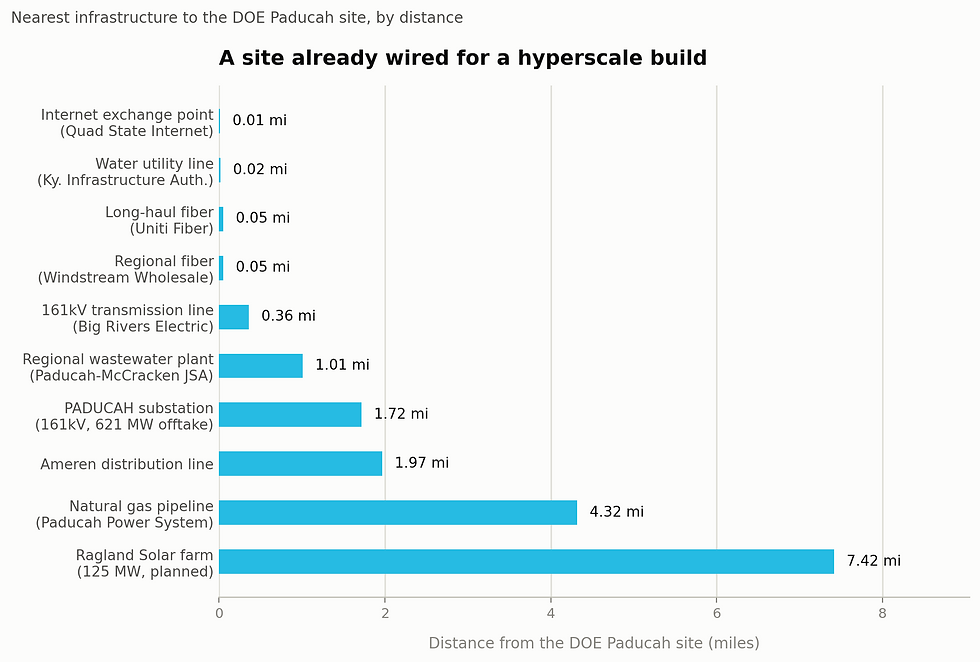
The parcel sits within a tenth of a mile of an existing internet exchange point operated by Quad State Internet and long-haul and regional fiber routes run by Uniti Fiber and Windstream Wholesale, giving a future campus a short path to network backbone without new long-haul builds. On the power side, a 161-kilovolt transmission line owned by Big Rivers Electric runs within about a third of a mile of the site, and the existing PADUCAH substation, 1.7 miles away, is rated for as much as 621 megawatts of offtake on its own, before counting any of the dedicated generation NextEra plans to build. A Kentucky Infrastructure Authority water line sits essentially on the property line, and the regional wastewater treatment plant serving Paducah and McCracken County, sized for a population of roughly 36,000, is about a mile away. The nearest natural gas pipeline, operated by Paducah Power System, is 4.3 miles out, and a Texas Gas Transmission receipt point 14 miles away shows more than 100,000 dekatherms a day of listed available capacity, headroom that could matter if the buildout draws on gas supply beyond what NextEra owns directly.
Why dedicated generation, not the interconnection queue
One reason NextEra and Brookfield appear to be building dedicated, behind-the-meter generation rather than routing the new load through the existing regional grid queue shows up clearly in LandGate's interconnection data for McCracken County.

Of the generation capacity that has sought to connect near the site over roughly the past fifteen years, most never made it online. Six projects totaling 969 megawatts, mostly solar, were withdrawn, and another 360 megawatts of signed agreements are currently listed as suspended. Only 346 megawatts sit in an active queue today, and just one 60-megawatt solar project is actually in service. The county has 58 substations on record but only a single active generator. Against that backdrop, a purpose-built, roughly 2-gigawatt gas plant with 2.6 gigawatts of storage, built and owned by NextEra specifically for this campus, sidesteps years of queue time that has swallowed most other projects in the area.
The environmental picture
LandGate's environmental screening for the site flags several real constraints. It lists 15 federally protected species with ranges overlapping the area, including nine endangered freshwater mussels (among them the fanshell, sheepnose, and pink mucket pearlymussel) and three protected bat species (gray bat, Indiana bat, and northern long-eared bat), plus wetlands covering more than 5% of the property that the tool flags as likely to need formal delineation before construction. Nearby protected land includes the Metropolis Lake State Nature Preserve, the West Kentucky Wildlife Management Area, Perkins Creek Nature Preserve, and several federal wetland conservation easements, along with city parkland. Soil suitability across the roughly 223 mapped units on site averages in the “moderate” range, though about 89% are rated “very limited” for structures with basements, a caveat that matters less for slab-built data center halls than it would for conventional buildings.
Those constraints sit on top of the site's Superfund history, and locally that combination is drawing scrutiny. Protect McCracken County, a citizens' group, has called for an independent environmental impact assessment of the new projects.
“Our biggest concern...is that you're doing it on a Superfund site.” (Erica Moore, Protect McCracken County)
Governor Andy Beshear's office has separately asked DOE for briefings covering power supply, environmental impact, job creation specifics, and the project's tax obligations.
What's still open in the DOE Paducah Process
The deal still needs Kentucky Public Service Commission sign-off on the power service agreement, and DOE has not named who will occupy the compute capacity once it is built. Construction is targeted to wrap by 2031, leaving several years for the environmental, regulatory, and community questions raised so far to play out alongside the buildout itself.
To learn more about the LandGate tools and data involved in this analysis, and how to access them for your project needs, book a demo with our dedicated energy & infrastructure team.


