
How to Do Due Diligence on a Data Center Site: A Step-by-Step Walkthrough

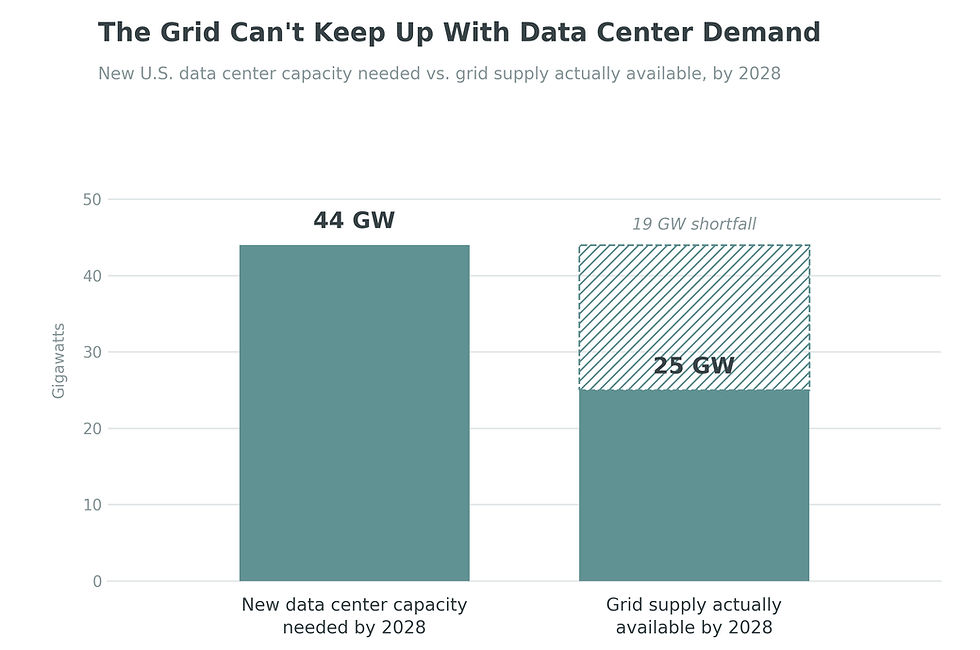
Half of the data center projects currently planned in the United States are being delayed or canceled outright, and it's rarely land or capital that kills them. It's power. The country's data centers run on roughly 51 gigawatts of capacity today, developers need about 44 gigawatts more by 2028, and the grid is on track to actually deliver only about 25 gigawatts of that in time, a 19 gigawatt gap between what's needed and what shows up. In markets like Northern Virginia, Phoenix, Chicago, and Silicon Valley, interconnection timelines for large loads already run three to five years, and some regions are seeing queue waits past six.
That's the environment data center due diligence has to work in now. A site that looks perfect on paper, good land, fiber nearby, a cooperative jurisdiction, can still be a dead end if the substation two miles away has no capacity left. Here's a walkthrough of the order to check things in, so the expensive research happens only after the cheap research clears.
Step 1: Confirm Substation Capacity Before Anything Else
Start with the single most common site-killer: available offtake capacity at the nearest substation. Identify the closest substation to the site and get two numbers, how far away it is and how much capacity it actually has left to give, not its nameplate rating. A substation can appear on a map three miles from a parcel and still have nothing to offer if it's already fully subscribed. Do this step before spending money on anything else; every other finding on this list is secondary if the site can't get power.
Step 2: Check the Interconnection Queue Position
Substation capacity today doesn't guarantee capacity when the facility actually needs to energize. Verify the site's position in the grid operator's interconnection queue, since that's what determines whether "available now" capacity is still available in two or three years. Given that queue waits in constrained markets are already running three to five years or longer, grid congestion data at both the substation and transmission level should be checked together, not treated as separate research tracks.
Step 3: Evaluate Behind-the-Meter Feasibility
If the queue position or available capacity looks marginal, the next question is whether the site can generate some of its own power. Assess on-site generation options: solar, wind, battery storage, or behind-the-meter natural gas, sized against the facility's expected peak load. This isn't just a backup-power question anymore; with the grid short by roughly 19 gigawatts of what data centers will need by 2028, behind-the-meter generation is increasingly what separates a site that can move forward on schedule from one that waits in a multi-year queue.
Step 4: Confirm Water, Fiber, and Resource Access
With power feasibility established, validate the physical resources the facility itself depends on: water access for cooling systems, and proximity to fiber infrastructure for connectivity. Neither is a power question, but both can independently stall a project if they're assumed rather than confirmed, and both are far cheaper to check now than after a site is under contract.
Step 5: Review Permitting Timelines and Community Reception
Local approval timelines and community reception can move a project's schedule as much as any grid constraint, and they vary enormously by jurisdiction. Research the specific permitting pathway and any local opposition history before assuming a straightforward approval, since this is the step most often skipped when a site otherwise looks strong on power and land.
Step 6: Evaluate Land Economics Last, Not First
Land cost, terrain, and parcel continuity matter, but only after power, interconnection, resource access, and permitting have already cleared. Evaluating land economics before confirming power availability is the most common ordering mistake in data center site selection: it's how teams end up attached to a site, sometimes under a signed option, before finding out the substation nearby has nothing left to give.
What Data Center Due Diligence Looks Like in Practice
Running these six steps individually across separate vendors and data sources is exactly what stretches due diligence timelines out for weeks. LandGate's Data Center Due Diligence Reports combine grid infrastructure proximity, offtake and interconnection analysis, electricity pricing, buildable acreage after exclusion zones, endangered species review, and state incentive data into a single report, and the Powered-Land Due Diligence Checklist walks through this same order of operations in more detail for teams building their own internal process.
The Takeaway
The 20 percent problem underneath most stalled data center projects isn't a land problem or a capital problem, it's a power problem, and it's why the order of due diligence matters as much as its thoroughness. Check substation capacity and interconnection queue position first, behind-the-meter feasibility and physical resources second, permitting third, and land economics last. Sites die when that order gets reversed.
Screen Your Next Site Before You Option It
With half of planned builds stalling on power constraints that show up early if you know where to look, the sites that keep moving are the ones where grid capacity gets checked before a letter of intent, not after. LandGate's Data Center, ATC Data, and Offtake Capacity tools surface substation and interconnection data at the point of site selection, and its Data Center Due Diligence Reports layer that on top of environmental, resource, and incentive data in one deliverable.
Request a Demo to see how your own shortlist screens against this data.
FAQ
How do I do due diligence on a data center site?
Check substation capacity and interconnection queue position first, since power availability is the most common reason planned sites stall or get canceled. Then evaluate behind-the-meter generation feasibility, confirm water and fiber access, review permitting timelines and community reception, and only then evaluate land cost and terrain. LandGate's Data Center Due Diligence Reports combine all of these into a single report.
Why do so many data center projects get delayed or canceled?
Roughly half of planned U.S. data center builds are currently being delayed or canceled, and the leading cause is power availability rather than land or capital. The U.S. needs about 44 gigawatts of new data center capacity by 2028, but the grid is on track to deliver only about 25 gigawatts of it, a 19 gigawatt shortfall.
What's the first thing to check when evaluating a data center site?
Substation capacity. Identify the nearest substation and confirm how much available offtake capacity it actually has left, not its nameplate rating, since this determines whether the rest of a due diligence review is worth running at all.
How long do data center interconnection queues typically take?
In constrained markets like Northern Virginia, Phoenix, Chicago, and Silicon Valley, interconnection timelines for large loads often run three to five years, and some regions see queue waits exceeding six years. Checking queue position early, alongside current substation capacity, is essential since capacity available today isn't guaranteed to still be available when a facility is ready to energize.
Should I evaluate land cost before or after checking power availability?
After. Land economics, terrain, and parcel continuity should be the last step in data center site due diligence, not the first, since a site can look attractive on cost and location and still be unbuildable if nearby grid infrastructure can't support it.


