The FLAP-D Constraint: Where Europe's Data Center Growth Is Heading Next


For two decades, Europe's data center map has been drawn around five cities: Frankfurt, London, Amsterdam, Paris and Dublin. Known collectively as FLAP-D, these hubs grew up around internet exchanges, financial centers and dense fiber, and they still hold the bulk of the continent's operating capacity.
But the FLAP-D model is running into a hard limit: power. Grid connections in several core hubs are now allocated years in advance, and regulators in the Netherlands and Ireland have moved from encouraging data centers to rationing them. New capacity hasn't stopped coming. It's going somewhere else.
LandGate's European data center layer tracks facilities by project status, which makes it possible to see where the next wave is actually being planned. The answer is clear: most planned growth is landing outside the traditional hub cities, even in countries that contain them.

The FLAP-D Constraint
The FLAP-D constraint refers to severe power, land, and regulatory bottlenecks in Europe’s primary data center markets: Frankfurt, London, Amsterdam, Paris, and Dublin. For decades, these five metros anchored Europe’s digital infrastructure due to their proximity to financial hubs, major internet exchanges, and dense population centers. However, the AI wave and accelerating cloud demand have pushed these traditional legacy markets to their operational limits.
Frankfurt: Germany's largest hub has effectively run out of grid. Local utility Mainova expects large new high-capacity connections won't be possible again until the mid-2030s, and greenfield projects inside the city itself are now effectively undeliverable. Germany's Energy Efficiency Act adds another layer, requiring new facilities to reach a PUE of 1.2 within two years of commissioning.
London: London and the Slough corridor remain the UK's core markets, but power constraints are pushing developers toward Hertfordshire, Oxfordshire, Wales, the North East, Greater Manchester and Scotland. The government is actively encouraging that shift through its AI Growth Zones program.
Amsterdam: The Netherlands bans new hyperscale data centers (10+ hectares or 70+ MW) across most of the country, with exceptions for a few northern sites. Amsterdam's grid operator Liander has warned that electricity shortages will persist until at least 2030.
Paris: France is the relative exception. Its nuclear-heavy grid has been less constrained than the other core hubs, and Ember's 2025 analysis singled out France as the FLAP-D market most likely to sustain new investment.
Dublin: Ireland emerged in December 2025 from a three-year de facto moratorium on new grid connections around Dublin. The new CRU policy lets data centers connect again, but only if they bring their own generation or storage and source 80% of annual demand from new Irish renewable projects.
Why Market Reports Disagree on Europe's Growth Leaders
If you've compared European data center outlooks recently, you've probably seen conflicting rankings. That's because most market reports measure capacity in megawatts, and they define "pipeline" differently: some count only projects under construction, others include committed or merely announced capacity.
A single 500 MW hyperscale campus can move a country up a megawatt ranking overnight. A facility count tells a different story: how many distinct projects are in motion, and how widely they're spread. Both views are useful, but facility-level data is what site selectors need when evaluating competition and grid demand around a specific parcel.
The figures below come from LandGate's European data center layer and reflect facilities with a Planned project status.
Country | Planned Data Centers (LandGate) | FLAP-D Market? |
Germany | 59+ | Yes (Frankfurt) |
United Kingdom | 52+ | Yes (London) |
Finland | 50+ | No |
Ireland | 45+ | Yes (Dublin) |
Spain | 33+ | No |
France | 25+ | Yes (Paris) |
Netherlands | 13+ | Yes (Amsterdam) |
Two patterns stand out.
Growth is leaving the hub cities, even within hub countries. Germany and the UK lead Europe in planned facilities, but most of that pipeline isn't in Frankfurt or London. Of Germany's roughly 60 planned data centers, 47 are outside the Frankfurt region. In the UK, 37 of 52 planned sites are outside London and Slough. Across both countries, about three in four planned facilities sit outside the FLAP-D cities.
The most constrained hub has the thinnest pipeline. The Netherlands, with its national hyperscale restrictions and Amsterdam's grid congestion, has just 13 planned facilities, the fewest of any FLAP-D country. Finland, a market that barely registered in European data center conversations a decade ago, has nearly four times as many.
Where Europe’s Data Center Growth is Heading Next
While Germany and the UK top LandGate’s rankings for total planned developments, a closer look at the geographic distribution shows that operators are pushing away from central city limits.
1) Germany: Beyond Frankfurt to Berlin and the Rhineland
As of October 2026, LandGate shows 59+ planned data centers in Germany. Only 13 of these proposed sites are in Frankfurt, and 47 of them are outside of Frankfurt. With Frankfurt's grid fully allocated, operators are expanding into the wider Rhine-Main region and secondary markets such as Berlin and the Rhineland.

Berlin has grown fastest, but it's already showing strain. Developers are also targeting brownfield coal sites in the Aachen-Bonn-Cologne-Düsseldorf corridor, where grid capacity already exists.
2) United Kingdom: AI Growth Zones Pull Capacity North and West
LandGate’s data shows 15 planned data centers in London/Slough vs. 37 outside London. These regions face acute power queues. To meet hyperscale cloud demand without waiting years for central grid upgrades, operators are expanding along secondary power corridors across the UK.
The UK has designated five AI Growth Zones: Culham in Oxfordshire, the North East, North Wales, South Wales and North Lanarkshire in Scotland. Zones receive priority access to available grid capacity. The government is also steering large loads toward Scotland and northern England, where high renewable generation and low local demand make power cheaper to deliver.
3) Finland: Cheap, Clean, Available Power
Perhaps the most compelling metric in LandGate’s platform is Finland, which ranks as the #3 country for planned data centers across all of Europe with 50+ planned facilities. Unlike Central Europe, the Nordics offer abundant, reliable zero-carbon energy (hydro and wind) with immediate grid access. Plus, the cold air in Finland dramatically lowers cooling costs and improves Power Usage Effectiveness (PUE) metrics.

Finland’s grid operator, Fingrid, often prioritizes data center connections, and about 95% of its power mix comes from CO2-free sources. Microsoft, Google, QTS, Nebius and DayOne all have projects underway or planned. However, Fingrid has temporarily restricted new connections above 10 MW around Helsinki, Turku and Tampere until 2027, and a reduced electricity tax rate for data centers ended in July 2026.
4) Ireland: A Big Pipeline With Strings Attached
Ireland is the outlier. Despite years of connection restrictions, it ranks fourth in LandGate's data with 45+ planned facilities. The CRU's new policy explains part of that: by replacing the moratorium with a defined path to connection, it reopened the door for projects that had been waiting.

But a planned facility in Ireland now carries heavy conditions. Projects must supply dispatchable generation or storage, commit to new renewable supply, and expect scrutiny of their location. The CRU flagged greater Dublin as constrained and also called out Galway, Limerick, Cork and Waterford as areas where data center demand could add to grid constraints. Ireland's pipeline is a reminder that "planned" doesn't mean "deliverable."
5) Spain: Renewable and Fast-Track Approvals in Aragón
Madrid remains Spain's primary data center cluster, but Aragón is becoming the country's destination for large-scale campuses. With key subsea cable landings (e.g., Bilbao, Barcelona, and Virginia Beach connections like Marea), Spain acts as a critical connectivity bridge linking Western Europe to LatAm, North Africa, and North America. Spain boasts some of Europe’s lowest-cost renewable power generation profiles, giving operators access to large-scale green PPA (Power Purchase Agreement) options - a crucial factor for meeting strict corporate sustainability goals.
What This Means for Developers and Site Selectors
The shift away from FLAP-D points to a few practical lessons:
Start with power, not proximity. Latency to a major internet exchange still matters for some workloads, but grid availability now decides which sites can be delivered at all.
Constraints follow growth. Berlin, Helsinki and inland Spain are all showing early signs of the same grid pressure that hit the FLAP-D hubs. Today's secondary market can be tomorrow's queue.
Read the pipeline locally. A country-level ranking hides the most important variable: how many planned facilities are competing for the same substation, transmission corridor or regional grid allocation.
Track Europe's Data Center Pipeline With LandGate
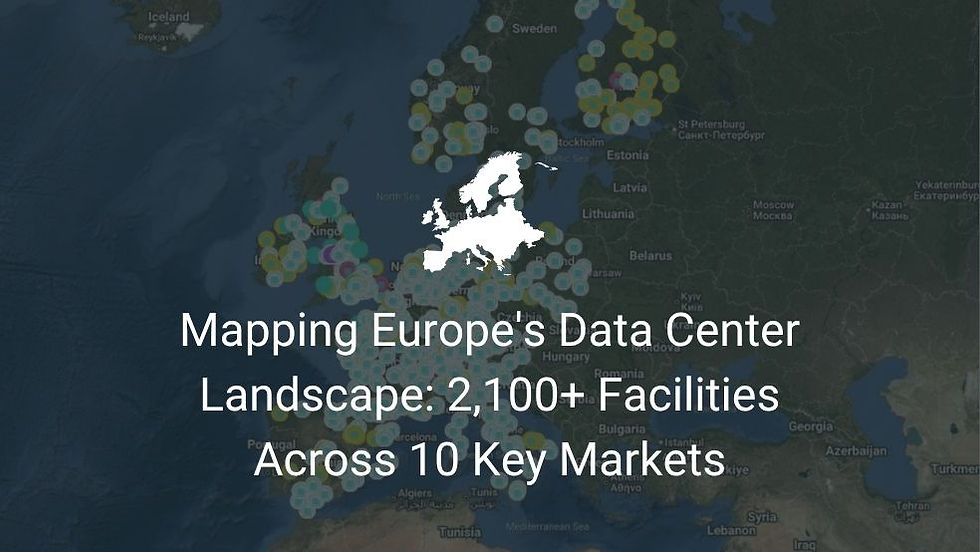
LandGate maps 2,100+ data centers across Europe, with project status for every site: Active, Proposed, Planned, Planned for Expansion, Denied and Withdrawn. Each facility includes operator details, gross power, white space, rack counts, PUE and on-site redundancy, so you can see exactly what's built and what's coming near any site you're evaluating.
As growth moves beyond FLAP-D, that facility-level view is what separates a viable site from one that's already oversubscribed.