
Mapping Europe's Data Center Landscape: 2,100+ Facilities Across 10 Key Markets

Updated: Oct 2
As hyperscale deployment accelerates and AI workloads push power density demands to record highs, site selection across Europe is undergoing a structural shift. While traditional core markets remain central to digital infrastructure, grid bottlenecks, tightening land availability, and complex local regulations are compelling developers to look beyond traditional boundaries.
To provide developers, site selectors, and energy professionals with clear spatial visibility, LandGate has expanded its map coverage to include European Data Centers. Users can now analyze site-level facility attributes, track project updates, and inspect operational statuses across international markets alongside primary domestic coverage.
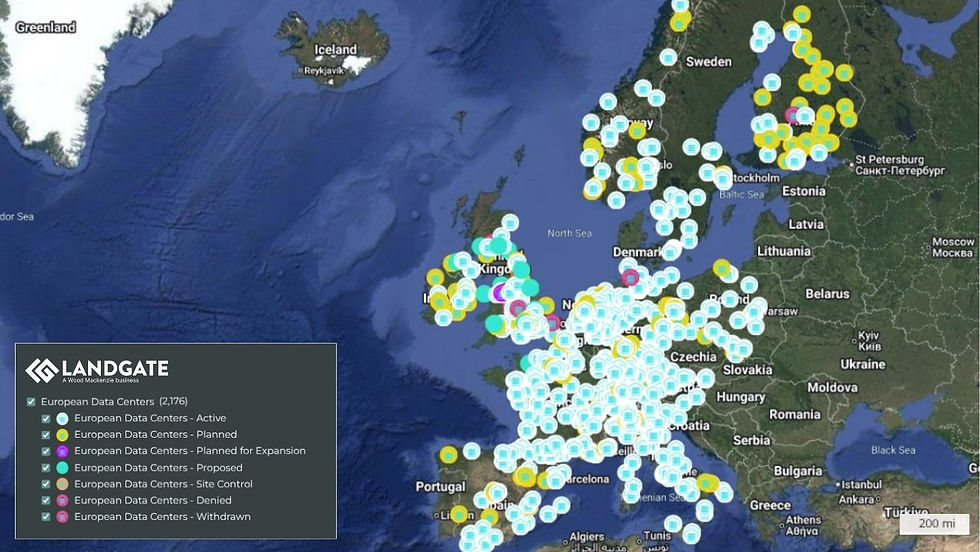
Across the top 12 European markets alone, LandGate tracks over 2,100 facilities spanning active, proposed, planned, expanding, and inactive projects. Below is a data-driven look at the facility counts, grid conditions, and regulatory environments shaping these 12 key markets.
How European Data Center Site Selection Differs from the U.S.
U.S. developers expanding into Europe will find familiar data center site selection fundamentals: power availability, fiber connectivity, land and latency. What changes is the regulatory and infrastructure landscape surrounding them. Under Article 12 of the EU Energy Efficiency Directive, data centers with at least 500 kW of installed IT power must report annual energy performance data (including PUE, water usage, energy reuse and renewable share) to a centralized EU database by May 15 each year. Member states can set lower thresholds, and several have. Germany applies its rules at 300 kW, while France uses 100 kW, bringing more facilities into scope.
Grid access presents another major constraint. Ireland, the Netherlands and the UK have introduced connection conditions, caps or prioritization schemes in response to growing data center demand. Understanding where existing and proposed facilities cluster and which projects have been denied or withdrawn can help developers identify where grid constraints are shaping the market.
These challenges are also pushing development beyond traditional hubs such as London, Frankfurt and Amsterdam, where land costs, grid constraints and permitting can make new projects more difficult. Developers are looking farther out for large parcels with available power, fiber connectivity and a viable path to grid access. For U.S. developers entering Europe, successful site selection increasingly means evaluating land, power, connectivity and permitting together - not in isolation.
Data Centers in Europe
Europe is becoming an increasingly important market for data center development, with major U.S.-based developers and hyperscalers expanding their footprints across the region. Operators including Microsoft, Google, Digital Realty, Equinix, CyrusOne and AWS are building or planning projects across European markets, as demand for AI, cloud computing and digital infrastructure continues to grow. LandGate has mapped more than 2,100 data centers across Europe, providing visibility into existing and planned infrastructure across key European markets.
LandGate’s European Data Center Coverage
Country | LandGate Facility Count | Primary Hubs |
United Kingdom | 500+ | London, Slough |
Germany | 450+ | Frankfurt, Berlin |
France | 250+ | Paris, Marseille |
Netherlands | 198+ | Amsterdam, Eemshaven |
Italy | 180+ | Milan |
Spain | 130+ | Madrid, Aragón |
Ireland | 122+ | Dublin |
Sweden | 121+ | Stockholm |
Poland | 107+ | Warsaw |
Switzerland | 105+ | Zurich, Geneva |
Finland | 95+ | Helinski |
Norway | 64+ | Oslo |
1) United Kingdom
500+ Data Centers Mapped in the UK on LandGate
The UK is LandGate's largest European dataset with over 500 facilities mapped, and London (particularly the Slough corridor west of the city) remains the country's dominant cluster. The government designated data centers as Critical National Infrastructure in September 2024 and has since launched AI Growth Zones, which bundle electricity cost discounts, a Connections Accelerator Service and faster planning. In late August 2026 the government rejected calls for a moratorium on new large data center approvals, and a revised National Planning Policy Framework published earlier that month strengthened planning support for the sector. The binding constraint is power: data center connection requests now exceed 70 GW, far beyond what the grid can deliver this decade.

2)Germany
450+ Data Centers Mapped in Germany on LandGate
Frankfurt is one of Europe's tightest markets, with long connection lead times. Germany also has the region's strictest efficiency regime. Under the Energy Efficiency Act (EnEfG), new data centers commissioned on or after July 1, 2026 must reach a PUE of 1.2 or lower and reuse at least 10% of their energy, rising to 15% and 20% for later commissioning dates. Existing facilities must hit a PUE of 1.5 by 2027 and 1.3 by 2030, and all covered data centers must run on 100% renewable electricity from 2027. For site selectors, proximity to district heating networks is now a real siting criterion.
3)France
250+ Data Centers Mapped in France on LandGate
France has become one of Europe's most aggressive data center growth stories. At the February 2025 AI Action Summit, President Macron announced roughly €109 billion in AI infrastructure pledges, including Brookfield's €20 billion commitment anchored by a 1 GW campus in Cambrai. France's low-carbon, nuclear-heavy grid is the main draw. Paris remains the primary hub, while Marseille has grown into an international connectivity point thanks to its subsea cable landings.
4) Netherlands
198+ Data Centers Mapped in the Netherlands on LandGate
Amsterdam remains a top-tier data center market, but development is heavily managed. A national rule bars new hyperscale data centers (larger than 10 hectares with 70 MW or more of capacity) outside designated zones in Hollands Kroon and Het Hogeland. Grid congestion in North Holland compounds the restriction, with distribution operators signaling limited power availability until around 2030. For developers, Dutch facility status data reveals which projects secured approvals before the rules tightened and where demand is spilling over.
5) Italy
180+ Data Centers Mapped in Italy on LandGate
Italy’s dominant data center market is Milan. Milan’s appeal is a combination of robust fiber optics, close proximity to Italy's largest business and financial center, established digital infrastructure, and access to power. Milan is also well connected to European and Mediterranean networks, making it attractive for both enterprise and hyperscale workloads.
6) Spain
130+ Data Centers Mapped in Spain on LandGate
Spain pairs renewable power availability with lower land costs. Madrid is the anchor market, benefitting from its position as the country’s largest business center with extensive fiber networks and cloud connectivity, plus access to international networks. Hyperscaler cloud regions in Madrid and Zaragoza have drawn colocation providers into both areas. Aragón in particular has become a destination for large-footprint campus development tied to solar and wind resources.
7) Ireland
122+ Data Centers Mapped in Ireland on LandGate
Dublin's data center density is matched by its grid constraints. Data centers consumed 21% of Ireland's electricity in 2023. In December 2025, the Commission for Regulation of Utilities finalized a new connection policy that requires new data centers to bring dispatchable generation or storage, onsite or nearby, matching their import capacity. They must also source at least 80% of annual demand from new Irish renewable projects, with a six-year glide path. The greater Dublin region is explicitly flagged as constrained, which makes location relative to grid capacity the deciding factor.

8) Sweden
121+ Data Centers Mapped in Sweden on LandGate
Sweden’s massive hydropower reserves, ultra-low carbon intensity, and competitive power tariffs make it a prime target for energy-intensive AI workloads. Key clusters in Stockholm, Falun, and northern regions like Luleå benefit from cold ambient temperatures that enable highly efficient free-air cooling. Sweden's national commitment to fossil-free industrial capacity makes it an ideal destination for ESG-focused site selectors and capital providers.
9) Poland
107+ Data Centers Mapped in Poland on LandGate
Data center demand in Poland is concentrated in Warsaw, Katowice, and Poznań. The regional grid in Warsaw is undergoing rapid modernization as developers work to pair new site builds directly with corporate power purchase agreements (PPAs) for solar and wind. Plus, Poland provides streamlined investment support and tax incentives through Special Economic Zones (SEZs) to attract large-scale capital investments in technology infrastructure.
10) Switzerland
105+ Data Centers Mapped in Switzerland on LandGate
Driven by local demand from financial institutions, enterprise headquarters, and pharmaceutical giants, Switzerland maintains a highly secure data center landscape centered around Zurich, Geneva, and Bern. The market is defined by exceptional grid reliability and high land values. Strict environmental noise regulations and municipal space limitations require developers to focus on high-density, compact facility designs equipped with advanced, low-noise cooling technologies.
11) Finland
96+ Data Centers Mapped in Finland on LandGate
Finland is emerging as a major European data center market, driven by abundant low-carbon energy, a cool climate, strong connectivity, and growing demand for AI infrastructure. While Helsinki remains an established hub, new hyperscale and AI developments are expanding into regions such as Seinäjoki, Lappeenranta, Kajaani, and northern Finland, where larger parcels and access to power create opportunities for campus-scale development.
12) Norway
64+ Data Centers Mapped in Norway on LandGate
Norway is becoming a significant European data center development market, particularly for AI/HPC workloads. Several enormous projects are driving Norway's current development wave, and the country's biggest advantage is available power. The interesting part for a site selection perspective is that development is spreading beyond Oslo into areas with abundant hydropower, available land, cooler climate, and large grid connections.
Turning European Market Context Into Site Decisions With LandGate
Market-level trends only take you so far. The questions that decide a project are site-specific. Who operates the facilities nearest your candidate parcel? How much gross power and white space do they carry? Which nearby projects are planned for expansion, and which were denied or withdrawn?
LandGate's European data center layer answers those questions at the facility level. Each site includes:
Facility attributes: data center type, site name, operator name and contact details, and exact location by address and latitude/longitude
Operational status: current status, year of operation, and project status (Active, Proposed, Planned, Planned for Expansion, Denied and Withdrawn)
Capacity and power: gross power, white space, number of racks, rack capacity, PUE and on-site redundancy
Combined with more than 6,200 U.S. facilities and 4,000+ international sites across 160+ countries, the layer gives developers, site selectors and their teams a single view of competitive supply worldwide. Detailed fields are available through export, so teams can bring facility data directly into their own site screening models.


